April 24, 2012

The Beginning of an Evil Scheme

Who wants space platinum? Well, I do. And I'm sure that there's a number of people who would like to have access to space resources like gold, water, and iridium for far more practical purposes. I just want a hunk of metal from space. Not a bit of metal launched into space, I want metal from space. Technically, all metal is from space and indeed is still in space, but dammit it's not the same!

Sorry. I just loves me some space. But happily, there are a passel of people getting together to make it easier for people to have access to rare materials not found on Earth that are necessary for our current and future technology, shiny things, and water (which can also be air and rocket fuel). Which is pretty sweet, and may well pay off in the end. A small asteroid could potentially contain billions of dollars worth of material, not even counting the water. Or the popplers!*

But how feasible, really, is such a crazy thing as mining an asteroid? Well, maybe not that crazy. First, did I mention the popplers? I mean billions? Second, it's not impossible. Now, in general, when someone says something like that you can start planning your shopping list in your head while helpfully nodding along. But in this case, there is no particular reason why we can't mine asteroids. It's just that we haven't done it yet. True, the technology isn't created yet that can do such a thing. Neither has transportation technology like on Star Trek. But for the latter, that's more a problem of basic physics and our lack of understanding of physics. But space mining? Well, we went to the Moon, Mars, and Venus. We've been to asteroids and other moons. So we already have pre-existing rocket technology that can get us to the destination. We've had telescopes for like what, a hundred years or something. And we can strip mine like anything.

Sounds nice and easy. But it ain't. First off, the tech doesn't exist. Even counting what I just said in the previous paragraph, it is going to take a lot of new hardware, a lot of new ways of thinking, in order to get a functioning space mining business off the ground. That's not to say it can't be done, especially seeing who's involved. But it will be difficult. Also, it will be expensive. Like, ridiculously expensive. Like, buy an island, blow it up, replace it with larger island, type of expensive. The people involved are billionaires, so they have that sort of cash. But they also ain't stupid. They are expecting this to work.

But what is going to work? Truthfully, I doubt that this particular venture will ever truly see fruition as envisioned. I don't doubt that we will one day see a congressional hearing on the appropriate way to levy space stuff. But that day is not today. However, I am quite excited by some of the other potential things going on with this. First off, they have to find the rocks. Which will require cheap and durable space telescopes, riding on the wings of dragons breath, or some similar poetic way to describe a rocket**. They will also have to actually go to and scout potential targets in order to determine their composition and suitability for mining. In other words, they will do what our collective governments should be doing: Identifying, studying and mitigating potentially life threatening asteroids.

This is my ultimate hope for the project. I want this to be the catalyst that not only raises awareness of such threats, but to also spur on governments to deal with them. Frankly, we are in an era when we can prevent our own demise, so long as we take the actions necessary to do so.

Oh, and here's some other stuff about this topic:
Space.com
SpaceRef
Bad Astronomy
Alan Boyle
Other Alan Boyle


* You didn't think chicken nuggets grew on trees did you?
** No, 'Giant Dong' is not poetic. This is a giant dong, and this is a rocket. Know the difference.

Share/Bookmark

April 13, 2012

Space Beer Adventure - In Space!


I have always wanted to go to space. Not only would it be awe inspiring, but you could also pull off some fun pranks. Like spinning your buddy around while they're in the middle of the room. Without gravity, and if you don't spin them towards a wall, they just whirl like a space dervish* until you're able to create a new viral video - "Vomit Spiral". It'll be hilarious.

Or it would be, if you didn't choose a friend who knew about the conservation of momentum and so flings their limbs out as soon as you spin them. Granted, this will still strand your friend and be mildly amusing. But you want that viral video, dammit, and that's never going to happen until your friend hurls! So you decide to jump towards your dizzy friend, momentarily forgetting that you won't come arcing gently down again, like on Earth. No, the only result of your foolhardy leap is to push your friend towards the space couch, where he will watch with much glee as you bounce of the walls like some screaming ping pong ball.

I think I may have an active imagination.

But I never imagined alcohol in space. I mean, I think you could have some nifty fountains in a space hotels space restaurant. I mean sure, it would help out with that spinning prank either way, you or your friend making the viral video. But as a general thing I wouldn't want people to have any more reason to have a queasy stomach than that already provided by being in microgravity.

Luckily, the recent news of 'space Scotch' is mostly about studying the effects of microgravity on maturation (of alcoholic ingredients such as malt and charred oak) and how certain chemicals and their aromas may be effected. So no space stills and space frat parties.

blizhe k malatsu sadyis!
Except this one.
Now some of you may be wondering what the hell NASA is doing wasting money on stuff like this. Which would be perfectly reasonable if it weren't for the fact that this is not a NASA study. It's a private distillery named Ardbeg that contracted Houston based Nanoracks to get their experiment onto the ISS.

Ok, so there are these people who build racks and modules for experiments to go into space. They also team up with CASIS to get those experiments onto the ISS. This means that any given company (like a Scottish distillery) can send their in-company research up into space. And that, my friends, is a prime example of commercial utilization of space.

But wait, I can imagine some of you saying. The ISS is a governmental venture, not private. Doesn't that invalidate the idea that this is a commercial venture? That argument could be valid, but only if this was the pinnacle and extent of commercial enterprise in space. But it's not! There are a number of people that are making all sorts of stuff to facilitate private individuals and business getting into space.

There's Xcor and Masten for launches, a ton of cubesat makers such as Boeing as well as a site that sells all the stuff you need to build one at home! Heck, there's even a website devoted to the freaking hobby of space exploration. Admittedly, it's a somewhat expensive hobby that consists mostly of weather balloons and sounding rockets. But still! Youtube has tons of stuff all about what can be done with a weather balloon.

'O Canada! Our home and native land...'


So no, the commercial argument is not invalidated. The ISS is a way point to a grander future. NASA is mostly serving as a facilitator and encourager more than a permanent resource (Of course NASA will in all likelihood continue to play host to commercial experiments in the future, but more as one choice amongst a plethora of others) NASA is mostly providing the scaffolding for a burgeoning market, plus some seed money to get things started.

Space alcohol sounds kind of silly, not unlike some of my space daydreams. But a story like that is really just one more sign of what's to come. We are fast approaching, and in some ways are already at, the day when going to space is cheap, easy, and you don't have to be a government employee to catch a ride on a rocket.

*That's the worst kind of dervish!

Also, here's some links to other stuff:


CASIS
The Space Review


Enhanced by Zemanta

Share/Bookmark

March 20, 2012

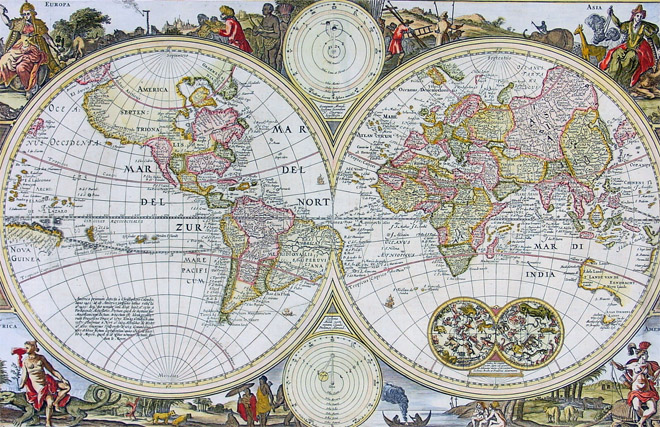
America Septentron

In looking for ye oldey maps (see previous post) I saw a lot of ... interesting things. Like, at one point, North America was called America Septentron. That's totally a Transformer, capital 'T' space robot Transformer, sort of name. I also found this, in which a Columbia University professor gives you a bunch of info about ancient history. I also found this, which is a really cool clock, and this, which can function as a clock but mostly makes me go 'Ooh, pretty!'
Share/Bookmark

America Sive In Dea Nova

Bad Astronomy | Discover Magazine:

'via Blog this'

A lot can happen, given enough time. But sometimes it is truly remarkable how quickly things can progress. It has been over four hundred years since Galileo first turned his telescope to the heavens and found that Jupiter was orbited by satellites of it's own. Let us consider the world of Galileo: Ships navigated by sextant, maps were ... interesting. The Dutch East India Company had just been founded and the New World was reached in boats that were little more that tar, timber, and nails.

But it is Galileo's new worlds that are of interest today. As Phil Plait mentions, when Io was first discovered we didn't even have accurate maps of the Earth. And now we have a photomosaic map of the Galilean moon Io at an accuracy that was not rivaled on Earth until the 20th century. In addition we have electricity, powered flight, instant pocket communicators, microwave ovens, rollercoasters, vaccines, plastic, life support helicopters, and really fast cars. We have put people on the Moon. Imagine what our world will be like four hundred years from now. I wonder what new worlds we will be exploring then.


Earth had a fat Antarctica back in the day. But then it took a stairmaster class at the local gym  and now it's buns and thighs look spectacular. Also, go to Ancient World Maps on Blogspot. They're pretty cool.

Enhanced by Zemanta

Share/Bookmark

March 05, 2012

CASIS

In 2005, along with then President Bush's 'Vision for Space Exploration', was a section (507) in the NASA authorization act of 2005 [Pdf] that made the ISS a National Laboratory. This makes sense, since it is the worlds highest laboratory (Sorry, High Times. They got you beat. Unless you wanna sponsor a study of the effects of Tetrahydrocannibinol on the human brain while in microgravity, they will always be higher than you. Sorry. But I'm sure that there will be lots of volunteers for that mission if you can talk CASIS into it). Included in that section was the authorization for NASA to contract with outside vendors for the management of the ISS-NL, which goes on to stipulate in 507(c)(3) that there should be a detailed plan for "the management structure for the laboratory, including the rationale for contracting or not contracting with a nongovernmental entity to operate the ISS national laboratory;"

I made this!
In 2011 NASA chose to use the nonprofit firm CASIS for the management structure, but I have yet to hear about the rationale behind that decision. I don't know why it took more than five years to decide to get an outside vendor. I would hazard that it may have something to do with the completion of the ISS, since the NASA Authorization act of 2010 [Pdf] says so in sec. 502. That wouldn't explain why they wanted a third party in the first place. Wouldn't NASA be best placed to decide how to use the laboratory it helped to design and build? Maybe there is a good reason for it, but I haven't been able to find any. Note, this isn't an accusation, more pointing out that it's hard to come by information regarding CASIS and why it was chosen.

Of course, it doesn't seem like CASIS has done much in the six months or so since it assumed responsibility. But that may well be due to an inefficient bureaucracy. Actually, that's not exactly true. I'm sure it's done a lot of stuff. But it's hard to figure out what they may have been doing. You see, as NASAWatch has been covering, there doesn't seem to be a lot of coordination between CASIS and anyone else. You almost never hear them mentioned when there is some new research on the ISS, or if there's a big conference about the ISS, or any other time really. But apparently it's a very stressful job (for not appearing to do much) since the executive director has recently resigned due to "...undue and onerous political pressures..."

I HAZ STARGATE
So what's up with CASIS? Why does it exist? What's the rationale behind it? What does it do, and what has it done? How did it get started? I know a little bit about that. CASIS was supported by Space Florida, an Independent Special District that is dedicated to the growth of the Florida space industry. Fair enough. These special districts are a little weird, but apparently commonplace. I hadn't heard of them before, but it seems a lot of states have them. They are usually created for one specific purpose, such as waste management or going into space. Anyway, CASIS is a big deal with them.

The more I dig into this the more confused I get. I can't seem to find any sort of narrative or explanatory themes to tie all of this together. There's holes all over the place, about why CASIS, why a third party at all, what has CASIS done, why aren't they more prominent in NASA press releases, why did Becker quit, why, why, why ... I don't know. I have a headache now. I'm just gonna post this with a bunch of links and have a lie down in a cool, dark room until my head stops exploding.

Links! Stuff that I read until my eyes got blurry, so now you get to read it too!
http://nasawatch.com/archives/2011/12/the-long-confus.html

http://www.space.com/12269-nasa-casis-nonprofit-space-station-research.html

http://www.nasa.gov/home/hqnews/2011/sep/HQ_11-294_ISS_NPO.html

http://www.pcmag.com/article2/0,2817,2392758,00.asp

http://nspires.nasaprs.com/external/viewrepositorydocument/cmdocumentid=256842/solicitationId=%7BBFE2288E-88A6-1FE1-DCFB-F94B9102C646%7D/viewSolicitationDocument=1/ISS%20National%20Lab%20Not-for-Profit%20CAN%202_14_2011%20Final.pdf

Yeah, that last one is the entire address. It comes from Nspires, the NASA Solicitation and Proposal Integrated Review and Evaluation System. I hadn't heard of this before either.

You know, I just bet that Space Law is one of the most complex and intricate legal arenas a person could dive into. Oh sure, international trading regulations are complex, probably even more so. But space law has got to be tough. So kudos to Michael Dodge and anyone else that majors in Space Law.

P.S. I almost never post pictures because, well, I don't know for sure. I just can't be all cool and stuff with graphics. Also, I never can find any that I like that are relevant. So the pictures contained in this post have, at best, a tangential relationship with the topic discussed.

Oh my god! UFO! Wait, no, it's just the Moon. Oh my god! What's that point of light to the right! It's a UFO! Oh wait, no, I had my ISO cranked up and it's just noise.

Enhanced by Zemanta

Share/Bookmark

February 29, 2012

Stats! Depressing stats, but they are easily accesible!

Nasa budgets: US spending on space travel since 1958 | Society | guardian.co.uk:

'via Blog this'

This article is really cool. Not only is it about space, it's about NASA's declining budget! Wait, that's not cool. That's the exact opposite of cool. It is uncool, if you will. Or rather, the fact that NASA has a declining budget is uncool. What's cool about this article is that the good people over at The Guardian have nicely compiled NASA's budget data since 1958. And they have made it freely available for download in a variety of formats. I just downloaded the Excel file and made this!


This took me all of about ten minutes. It would have been less, except I have only the foggiest notion of how Excel works. Which is absolute proof that any idiot can use this data that The Guardian has so kindly supplied about NASA's budget.

Wait, you mean that British newspaper? That's cool. I wish we had cool newspapers like that, who would compile data about the government and then make it freely and easily available to any one who wants it. Is it apparent yet that I think Hans Rosling is cool?I mean jeez, I've used excel like what, once? And that was to create a 'budget' that was an awesome idea for about an hour and then I saved the document and promptly forgot about it. But lookit pretty graph! Hooray!

So you know what, hats off to The Guardian for supplying such excellent information for me!

"Can you do anything with this data?"
Enhanced by Zemanta

Share/Bookmark

February 28, 2012

Living Longer Than 40 - Thanks Science!


Living Longer Than 40 - Thanks Science!

In the movie Jurassic Park, Jeff Goldblum's character Ian Malcolm is explaining to Laura Dern's  character Ellie Satller a bit about chaos theory, and how similar events can lead to vastly different outcomes. In his example, that would be the placing a drop of water onto Dr. Sattler's hand and seeing where it rolled off too. In my case the similar events are a rather silly question.

I see this type of sentiment sometimes here and there. People express it differently to be sure, but it happens a lot. The question comes in many different flavors, each with their own nuance and character, but they all essentially boil down to one simple question "What has science done for me?/done for me lately?" What's different about this time? Nothing! Nothing that I can tell, anyway. What got me going was a comment online (yeah, you'd think I'd learn, but no) Someone said that the space program is a waste of money. I've heard it before and I'll hear it again.  So why did this one get under my skin? I blame Jeff Goldblum. 

So in response to that mentality, here's a list of stuff!

  • Flying - Thanks Science!
  • Not contracting polio - Thanks Science!
  • Cell Phones - Thanks Science!
  • The Internet - Thanks Science!
  • Connecting to the internet on my cell phone while flying and not dying of polio - Thanks Science!
  • Dr. Pepper and the containers thereof - Thanks Science!
  • Distillation - Thanks Science!
  • Plastic - Thanks Science!
  • For the numerous contributions to construction, architecture, chemical adhesive, latex paint and everything else that went into making the chair your sitting in, the house your living in, and the bridge you drive on - Thanks Science!
  • Lasik Eye Surgery - Thanks Science!
  • Surviving Surgery - Thanks Science!
  • Germ Theory and Sanitation - Thanks Science!
  • Penicillin - Thanks Science!
  • Living with diabetes - Thanks Science!
  • Surviving a heart attack - Thanks Science!
  • Pacemakers - Thanks Science!
  • Chemotherapy and those who live - Thanks Science!
  • Knowing our origins - Thanks Science!
  • R/C Cars on other planets - Thanks Science!
  • Hubble Deep Field - Thanks Science!
  • The Pale Blue Dot - Thanks Carl!
  • Comprehending the vastness of the universe, and our place within it - Thanks Science!

The next time someone asks you a question like, "What has science done for me lately?", you look them straight in the eye and ask them, "What have you done for science … ever!?"
Enhanced by Zemanta

Share/Bookmark

February 26, 2012

Cleaning Day

Today is unusual. Not that I was cleaning, you see, but what I was cleaning*. I was cleaning my junk drawer. Which is doubly bad because that's in the kitchen. You see, it's easier for me to work up the fortitude for cleaning if what is going to be cleaned is in my line of sight as a general thing. My living room stays cleaner than my bedroom. I don't use my kitchen much. Sure, the area in front of the microwave is generally clear of stuff that would prevent me from opening the door, but other than that, not much happens in the kitchen by way of cleaning.

I'm sure that you can imagine then how rare it is for me to clean out the junk drawer. I did find some cool stuff, like peel and stick hooks and a relatively fresh pack of gum, unopened. I also now realize that I'm set for awhile for AAA batteries. They are tiny, so they can come in tiny packs, and I only ever needed them in pairs, and so I bought them in small packs, and the packs would get buried in the junk in my drawer so each time I needed a new pair I would buy a whole new pack and now I have 33 batteries. Oh, 35 if you count the two AA ones I found.**

On the other hand I did find amusement in reading some of the old sets of instructions for replaced, broken or simply missing electronics and other gadgets. I especially enjoyed certain warnings and general tips, like

"Non-rechargeable batteries are not to be recharged" Really! How'd you deduce that then?

If you have rechargeable batteries then "[They] are to be removed from the product before being charged (if removable)" Golly!

In case you're wondering, "Battery insertion must be done by an adult."

"Exhausted batteries are to be removed from the product." Yes boss! (Makes sense, too. I know my work performance degrades when I'm exhausted)

This one does have a certain safety aspect to it. "The supply terminals are not to be short circuited." But really? If they mean the terminals on the battery, well, that's actually kind of hard to do by accident. Unless you habitually leave your batteries in the random bag of screws found in all junk drawers everywhere. In which case the cost of the new kitchen drawer should serve as a good lesson against such a habit.* If they mean the terminals in the battery compartment, then that's silly. It would take someone modifying the product in such a way as to void any legal responsibility by the manufacturer of the product. Like, the guy who puts new shocks on his car, but screws it up, and then sues the car company because the car only and constantly turns left. The car company is under no obligation to idiots who break their personal belongings. And any one capable enough to modify the product without screwing it up already knows not to create a short circuit anyway. So this one is totally useless.

You know, I would expect such a hefty list of warning concerning batteries to be on a pack of batteries. I only listed the funniest ones, and they didn't even make up half the list. But no. This list doesn't occur on a pack of batteries. Maybe because all the ones I could find were small. No, these warnings were in the instructions for a clock! The thing didn't even come with batteries! So why all the warning? I guess it's for protection, but I reserve the right to get amusement from it!

Plus, given my profundity of batteries and my storage method (haphazardly thrown into a drawer) it's probably a good thing I have such an extensive battery safety resource at my fingertips.

*Cleaning in general is unusual in that it's rare, but it goes in patterns and cycles, so its not unusual in that it's a strange occurrence.

**Did I mention that my remote dies today? It takes four AA batteries.

***Or the cost of a new kitchen, if you stored the batteries and screws near any flammable materials. Like may happen in a junk drawer.
Share/Bookmark

February 11, 2012

Reuse


'via Blog this'

I understand that we can't keep every mission going for as long as they retain at least some function. Not everything is a Voyager or Opportunity. Some missions have simply lost so much functionality that the cost of maintaining the mission with a full up NASA staff has become economically unviable. This is bound to occur, even at the best of times.

But a loss of some functions is not a complete loss, at least not always. It would be nice to have some way of continuing what scientific or observational functions a satellite may have after being decommissioned by NASA. I think it would be awesome if there was a way, some system, that allows companies and universities to buy or use defunct satellites. Hopefully, what's going on with the GALEX* satellite will set a precedent for creating such a system.

Now, there is one sorta downside to this. In good times, when the socio-politco-economic climate is such that we can engage in science with wanton abandon (or at least in carefully reasoned fits of wanton abandon), there won't be a lot of semi-functional satellites available. But they probably wouldn't be needed anyway, so that's fine. On the other hand, in bad times there will be more, and better functioning, satellites available simply because more satellites would get the official axe.

This has possibilities...

*Totally a name from Dr. Who, or oughta be.
Enhanced by Zemanta

Share/Bookmark