Here's how I see climate science: That in any given complex system, the components of said system will, whenever possible, fall into equilibrium (dynamic or otherwise) with the other components. Without any major changes to the constituency of the components, that system will continue to maintain that equilibrium. Thus when conditions on Earth are maintained in a certain way (say, lots of carbon in a denser atmosphere) then the Earth's climate will continue to maintain those conditions. If there is a change in those conditions, by maybe an asteroid or an industrial revolution, then Earth's climate will respond by seeking out the closest point of equilibrium, given the new conditions.
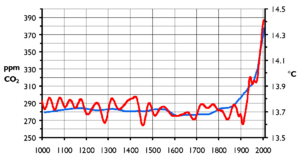 |
| Atmospheric carbon dioxide concentration and mean global temperature during the past 1000 years. Carbon dioxide levels (blue line, left-hand axis) are given in parts per million (volume), temperatures (red line, right-hand axis) in degrees centigrade. (Photo credit: Wikipedia) |
We can see that there are climate paradigms that last for long periods of time, sometimes for millions of years, and that those paradigms can
change over time. While it is possible to have relatively rapid, and therefore catastrophic, changes between two climate paradigms, most often this climate change is gradual, and has much variation during that change. But on the rare times when there is a change big enough to threaten the survival of vast amounts of life, like when life produced an
over-abundance of oxygen or when the dinosaurs bit it, the environment can change drastically rapidly.
The way I understand it, climate science figures that we've been in one of these climate paradigms for a while now, at least since the last ice age. Oh sure, we've had regional and even global variations, but we have been living in one climate paradigm since civilization began. There is a concern that the recent influx of carbon in various forms into the atmosphere since the industrial revolution is causing our climate paradigm to change. In our particular case, the extra chemicals, mostly CO2 and methane (with caveats), are worrisome because they can let certain forms of light pass through them and block other forms. Now, all chemicals have this ability, but in the case of these gases, they
let in UV and visible light, and block IR light. The UV and visible light heat up an object, like Earth or you. This heat can then radiate into the air near the ground, and rise up, being replaced by cooler air from above. However, this only transfers the heat energy from one place to another. First it's in the sunlight streaming through the atmosphere. Second, it's the heat generated by that light interacting with the Earth and its atmosphere. Third, it's that heat in the atmosphere.
Now some of you may be wondering, if light heats up the ground, which then heats up the air, and that air rises up being replaced by cooler air from above, how did the air above become cooler than the air on the ground? This raises a crucial point: Whatever energy Earth takes in from the sun must be used or discarded. Sunlight can be used to help a
plant grow. This in turn feeds an animal. The energy in the plant is converted into energy for the animal, thus allowing it to move. Some of the energy we receive from the sun goes into making life happen. What about the rest?
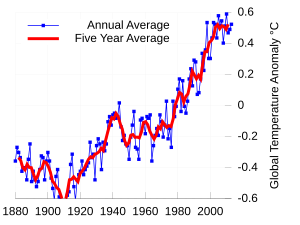 |
| Global mean surface temperature difference from the average for 1880–2009 (Photo credit: Wikipedia) |
As you ascend through the atmosphere, the air becomes less dense. Any liquid or gas that expands into a
low pressure area will cool down. This explains why, in general, the atmosphere above is cooler than the air below. But as that air descends it condenses, which heats it back up, so there's not a net change in air temperature from that. (The process isn't completely
adiabatic, due to friction between molecules and the afore mentioned thermal
conduction)
But what does happen is
thermal radiation. That is, as any given object heats up, it emits some form of light. The cooler an object is the lower the frequency and the lower the amplitude of light that is emitted from that object. For most things that exist at the surface of Earth, and at the temperatures one generally finds on the surface of the Earth, we glow in the infrared. Crafty observers will note that CO2 and methane lets in the type of light that will heat up an object, causing it to glow in the infrared, which is then blocked by those same gases. The end result of this is that, while the amount of energy we receive from the Sun stays relatively constant, the amount of that energy radiated back into space drops. This is the same trick used in greenhouses (in addition to being a sequestered environment) that allows them to stay warmer than their surroundings, and also explains why these gases are called greenhouse gases.
That is, I think, the essence of global warming: The Earth's climate will move from one climate to another, warmer paradigm, due to an excess of carbon dioxide. It is the time in between that is of most pertinent concern to us, and that time is called climate change.
The end result of this current predicted round of climate change is a warmer climate, and so the overall trend will be one of warmer temperatures. However, a radical change in any given system will create a bit of
chaos until a new equilibrium is
reached. For us this means a few things: The average global temperature will rise. Most regional temperatures will rise over a long enough time scale. There will be significant regional variation, in two separate ways. Some regions will be significantly hotter while others, maybe even adjacent, are significantly cooler. Some areas will be dry and other may be wet. There will also be regional variation through time. That is, one region may experience cold and dry weather for a few decades before shifting to hot and wet for another few decades.
Furthermore, the atmosphere will be both hotter and wetter, as warmer air holds water easier than cold air.
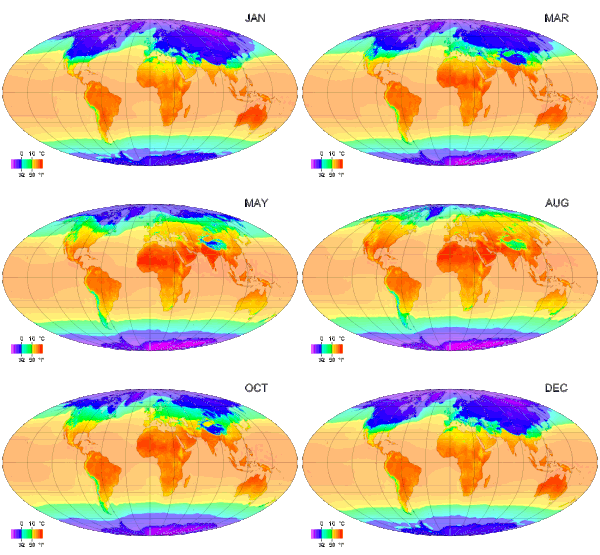 |
| English: Animated global map of monthly long term mean surface air temperature (Mollweide projection). (Photo credit: Wikipedia) |
This will result in not necessarily more storms, but what storms do occur will likely be much
more powerful as the temperature increases. As far as I can tell, the poles will, on average, heat up much more than the equatorial areas. This means that annual ice pack concentration will fall. This will release extra water into the world’s oceans, changing the chemistry of the oceans (
something CO2 also does), raising overall ocean levels, and changing Earth's albedo (Albedo=Shininess!) such that the oceans absorb more sunlight and thus heat up faster. The warmer weather near the poles may possibly allow some areas of permafrost to thaw. Some areas of permafrost also contain
high levels of methane. Methane is also a greenhouse gas, but one that is much more potent. So it's a good thing that we produce much less methane than CO2. But it's unfortunately possible that the heating caused by increased CO2 could end up releasing vast quantities of methane into the atmosphere. This would not be good.
Some may argue that CO2 is only 0.0387%, a change of 107 parts per million from pre-industrial levels of 0.028% of the
atmosphere. How can such a piddly amount do anything significant to our planet? I say, change out 0.0107% of your body volume with arsenic. What happens? You die.* The effects of one element in a system is not always weighted according to the total amount of that element. It's what that element does that is important. In this case, it kills.
There has been a measured rise in atmospheric CO2 for the past hundred and fifty years or so. When all natural sources are accounted for there is a disparity between what is accounted for (that which naturally produces and absorbs CO2), and the measured rise in CO2. It is not until we factor in the CO2 released by human actions that we have a balanced accounting of CO2 production and consumption. Human beings are adding significant amounts of CO2 to the atmosphere. Taking what we know of physics, chemistry, biology, math, statistical analysis, and a myriad of other disciplines, and combining it with our observations of the world, leads the vast majority of scientists, especially those who conduct climate science, to the conclusion that the Earth is warming up, that this time will be climactic and probably not a lot of fun, and that human emissions are responsible for this sudden shift in
climate paradigms.
Is this alarmism? Is this exaggeration or flat out lies, is climate science a bunch of snake oil, doomsayers selling lies for profit? Are scientists telling everyone that the ship is sinking, and oh by the way I sell life jackets? Or are they up in the crow’s nest, spotting icebergs? Will we force them to be the captain, giving the order to abandon ship?
All evidence points to climate change being real, that the consequences of that change will have drastic consequences for humanity, and that we are the main force creating this situation.
All investigations into the
people conducting climate science have
proven them to be
honorable in their dealings. The science is
sound. The scientists are sound. We have to deal with this situation. We can continue as we have, damn the torpedoes. Or we can choose to change.
*To look at it another way, if you were 3% water by volume, you'd also die.
Notes:
I have used the New Scientist as a primary resource, with the addition of Wikipedia for ease of access and for its straightforward summation of topics. I have tried to avoid technical papers wherever possible.
Furthermore, I am absolutely certain that I have missed important points or oversimplified certain concepts. The most glaring omission is a discussion regarding the oceans. However, I feel that the links provided have plenty of information on that topic, and its omission does not change in any significant way my conclusions.
Additional Sources:
Jim Hansen's Climate Predictions
Timeline of Climate Change research
New Scientist Blog - Climate Myths
IPCC
EPA - Climate Change
NASA - Climate Change
Skeptical Science, especially their
Climate Change Myths page
Nature - Climate Change
PEW Center on Global Climate Change
If you have any additional resources that should be added, or have any other comments, please let me know.

Here Comes Chaos


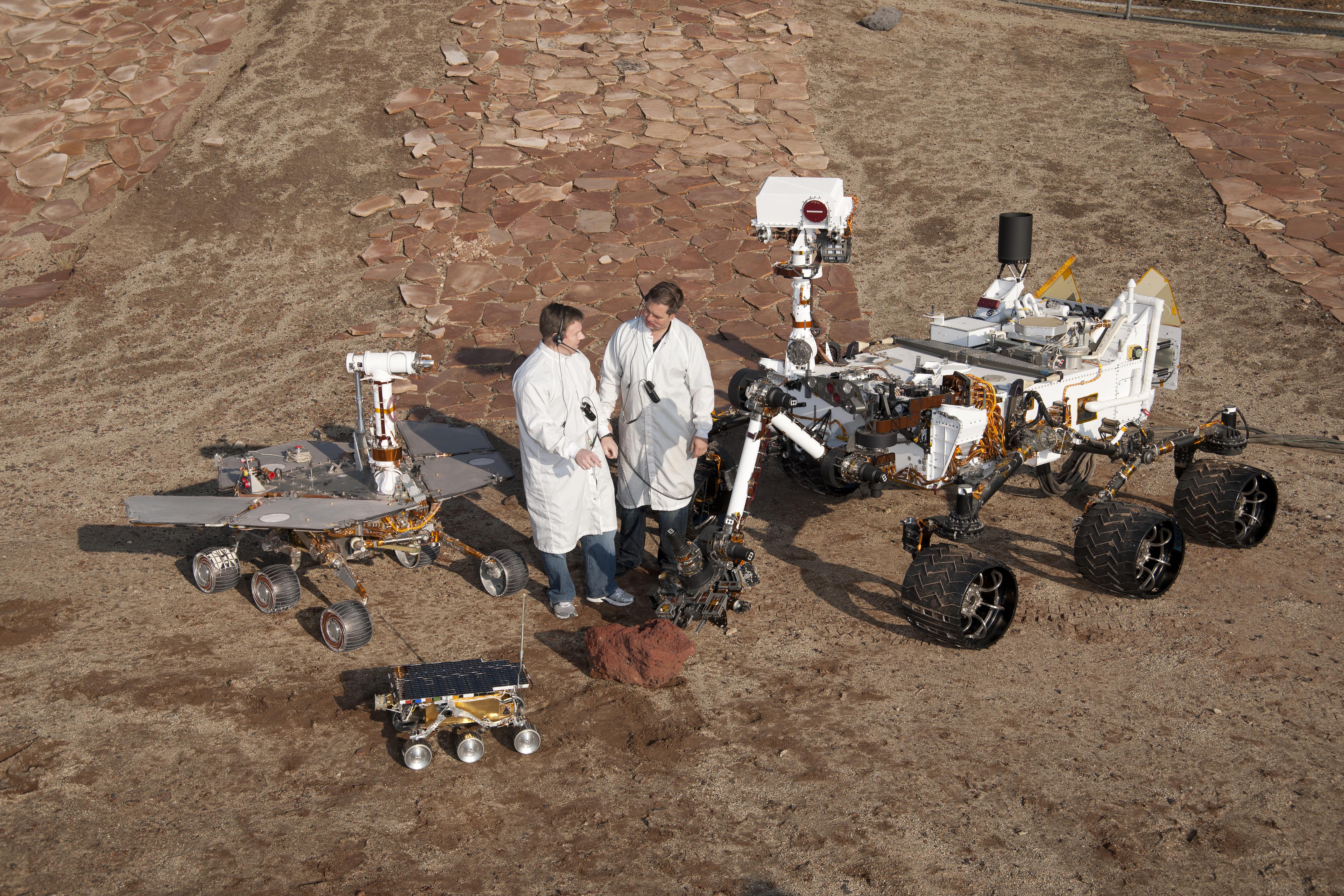
 I may have used a really liberal definition of the term 'interpret' towards the end there, but I think that's what he was trying to say. He sort of stumbled a bit making the transition from talking about Curiosity to the people who built and run the rover. Happily, Colbert jumped in with a quick summary point that allowed Grunsfeld to make his point simply by agreeing. Regardless, I'm pretty psyched about this. Curiosity will create a huge leap forward in our understanding of the red planet. It will have a Mastcam for large, panoramic shots. It will have a microscope camera for analyzing samples. It will come equipped with multiple spectroscopes, including laser and x-ray induced spectroscopy. Curiosity also comes with a radiation detector, which will help determine viability for human missions. The rover will have an environmental testing station, measuring such things as temperature, wind speed, and air pressure, and a way to test for water ice at or near the surface, plus some other stuff that I didn't dive into. I guess instead of of life support, they loaded this thing down with pure science.


 South Carolina:
Article 27, Section 4 states: "No person who denies the existence of a
Supreme Being shall hold any office under this constitution."
South Carolina:
Article 27, Section 4 states: "No person who denies the existence of a
Supreme Being shall hold any office under this constitution." Arkansas: Article 2, Section 26 states: "No
religious test shall ever be required of any person as a qualification to vote
or hold office; nor shall any person be rendered incompetent to be a witness on
account of his[sic] religious belief; but nothing herein shall be construed to
dispense with oaths or affirmations."
Arkansas: Article 2, Section 26 states: "No
religious test shall ever be required of any person as a qualification to vote
or hold office; nor shall any person be rendered incompetent to be a witness on
account of his[sic] religious belief; but nothing herein shall be construed to
dispense with oaths or affirmations." Mississippi:
Article 3, Section 18 states: "No religious test as a qualification
for office shall be required; and no preference shall be given by law to any
religious sect or mode of worship; but
the free enjoyment of all religious sentiments and the different modes of
worship shall be held sacred. The rights hereby secured shall not be construed
to justify acts of licentiousness injurious to morals or dangerous to the peace
and safety of the state, or to exclude the Holy Bible from use in any public
school of this state. "
Mississippi:
Article 3, Section 18 states: "No religious test as a qualification
for office shall be required; and no preference shall be given by law to any
religious sect or mode of worship; but
the free enjoyment of all religious sentiments and the different modes of
worship shall be held sacred. The rights hereby secured shall not be construed
to justify acts of licentiousness injurious to morals or dangerous to the peace
and safety of the state, or to exclude the Holy Bible from use in any public
school of this state. " Tennessee:
Article 1, Section 4 states: "That no political or religious test,
other than an oath to support the Constitution of the United States and of this
state, shall ever be required as a qualification to any office or public trust
under this state."
Tennessee:
Article 1, Section 4 states: "That no political or religious test,
other than an oath to support the Constitution of the United States and of this
state, shall ever be required as a qualification to any office or public trust
under this state." Texas:
Article 1, Section 4 - "RELIGIOUS TESTS. No religious test shall ever be required as a
qualification to any office, or public trust, in this State; nor shall anyone
be excluded from holding office on account of his religious sentiments,
provided he acknowledge the existence of a Supreme Being."
Texas:
Article 1, Section 4 - "RELIGIOUS TESTS. No religious test shall ever be required as a
qualification to any office, or public trust, in this State; nor shall anyone
be excluded from holding office on account of his religious sentiments,
provided he acknowledge the existence of a Supreme Being." Maryland:
Article 36 - "That as it is the duty of every man to worship God in
such manner as he thinks most acceptable to Him, all persons are equally
entitled to protection in their religious liberty; wherefore, no person ought
by any law to be molested in his person or estate, on account of his religious
persuasion, or profession, or for his religious practice, unless, under the
color of religion, he shall disturb the good order, peace or safety of the
State, or shall infringe the laws of morality, or injure others in their
natural, civil or religious rights; nor ought any person to be compelled to
frequent, or maintain, or contribute, unless on contract, to maintain, any
place of worship, or any ministry; nor shall any person, otherwise competent,
be deemed incompetent as a witness, or juror, on account of his religious
belief; provided, he believes in the existence of God, and that under His
dispensation such person will be held morally accountable for his acts, and be
rewarded or punished therefor either in this world or in the world to come.
Maryland:
Article 36 - "That as it is the duty of every man to worship God in
such manner as he thinks most acceptable to Him, all persons are equally
entitled to protection in their religious liberty; wherefore, no person ought
by any law to be molested in his person or estate, on account of his religious
persuasion, or profession, or for his religious practice, unless, under the
color of religion, he shall disturb the good order, peace or safety of the
State, or shall infringe the laws of morality, or injure others in their
natural, civil or religious rights; nor ought any person to be compelled to
frequent, or maintain, or contribute, unless on contract, to maintain, any
place of worship, or any ministry; nor shall any person, otherwise competent,
be deemed incompetent as a witness, or juror, on account of his religious
belief; provided, he believes in the existence of God, and that under His
dispensation such person will be held morally accountable for his acts, and be
rewarded or punished therefor either in this world or in the world to come.

.jpg)
