Showing posts with label Science. Show all posts

July 06, 2012

A Substantial Image

What's in a name? Would a font by any other name be as hated, or would it convey the content of the words any differently? I'm talking about comic sans font, its detractors, and the scientist who use that font. You see, CERN decided that it was high time to admit that they have possibly found something that could be a Higgs Boson (this is how a scientist talks when they're only 99.9998% sure about something). They decided to use comic sans in their presentation slides. This has not been taken well by the internet.

Now, the sci-ence comic isn't that big a deal - They're a comic; they're allowed to make snarky comics about such things. But really, Verge, 256 comments, many of them vitriolic? Yes, comic sans is slightly whimsical. But it is also easy to read, is widely available, and starts with 'c', so it's near the top of the list of fonts you need to scroll through to find a font.  I haven't heard of CERN science teams submitting research to journals using comic sans. Nor has there been a ruckus raised over their use of comic sans for their press releases. No, the only time they used comic sans was in their presentation to an auditorium of people who worked on the project. They were jubilant, and can be forgiven for feeling slightly whimsical.

Or maybe they just wanted something that was easy to read. This was being presented to a fairly large crowd, with a video feed to the internet. Legibility may have been an important factor. Or maybe the creator of the slides wasn't concerned too much with the font, and went with the first one they liked.

This whole thing seems rather shallow. "Oh my!" cries the internet, "the particular shape of these perfectly readable letters is not to my aesthetic satisfaction! Quick, we must write about this absurdity, for that is far more important than what those scientists were actually talking about!" Apparently form is everything and content is nothing. Image far outweighs substance.

And isn't that what really matters? The discovery of a new fundamental particle is truly historic. Thousands of people have spent uncountable hours of their lives in pursuit of this discovery. It has taken decades, and there were many setbacks. But they kept at it, steadily plugging along until finally, at the end of all that hard work, they had a graph with a bump right where they expected a bump to be. This is far more awesome than I just described. Ultimately, I don't care what font is used to present amazing new discoveries; I care that the discovery was made. So long as the slides are legible, I am happy.


Share/Bookmark

June 09, 2012

The Shininess of my Shoes is NASA Approved

I am unable to see my house from here

For those of you not in the know, Phil Plait is a bad astronomer. Not that he's bad at astronomy, but that he's got a website called Bad Astronomy. In addition to discussing and debunking bad astronomy and pseudoscience, he also talks a lot about real science and how awesome it is. So yeah, he's pretty cool. Go check it out.

But wait, you may say, he's just a blogger! Yes, but a blogger with a Ph.D. who worked with the Hubble Space Telescope, so he knows what he's talking about. But there are other Ph.D's who don't write blogs, such as the illimitable Alan Stern. He spends his time being the principle investigator for the New Horizons probe (You know, the one headed for Pluto), as well as a number of other planetary science related stuff (Can't you just taste the irony?). Any way, he's also awesome.


Dr. Stern decided that the 20% cut in funding for planetary science was not that awesome, and so he decided to do something about it (Wait, didn't we lose about 20% of our planets recently?). He organized a cross country bake sale/car wash/ shoe shinin', and Dr. Plait wrote about it. And I participated! Or rather, I drove up to Boulder today so that I could sign the letters to various government officials that basically said, 'Hey, remember that 20% cut in funding? Yeah, that was dumb. You go right on ahead and fix that chop chop.' And guess who was there?

Fun fact for the day: I turn into a stuttering fan boy when I meet people like Dr.'s Stern and Plait (That should totally be a band name, btw). I hope I didn't weird them out too much. But whatever. I met them! It was awesome. Dr. Stern shined my shoes. I asked a question, and they answered it! I also ate a cinnamon roll. Then I took a hike, and pictures of stuff I saw on my hike. Like, pretty flowers, and butterflies, and butterflies engaging in dog fights with other butterflies. I never knew those little flapping pieces of pretty were so aggressive! At least, they are with each other. Every time I tried to get with in a few feet of them (for the taking of pictures) they would flit away. But if I stood still, they would ... flit around far away from me. Too far for me to take good pictures.


But I'm a patient person (Oh crap, I hope that doesn't make me virtuous! That would totally destroy my street cred. Looking at butterflies and flowers is 'street', right?) I stood stock still, camera at the ready at chest height. That's when the butterflies got wise and started messing with me. They would flit in close, but before I could take any pictures they would be off again! So finally I decided to just sit and enjoy the spectacle of Top Gun quality butterfly dog fights. So what happens, now that my camera is at my side? They wouldn't leave me alone. There they'd be, flapping there flying superiority at me, being all close up and stuff, while I got indecisive about whether or not I should reach for my camera. Turns out I shouldn't, because as soon as I moved they would fly away again.

He won every dog fight. It was amazing.
This guy was about as big as my hand, and he totally dominated the skies today. Also, pretty!
But I did get a bunch of blurry pictures of vaguely butterfly shaped blurs, and one or two that weren't hardly blurry at all! So all in all, today was pretty freaking awesome for me. Woot!
Enhanced by Zemanta

Share/Bookmark

May 25, 2012

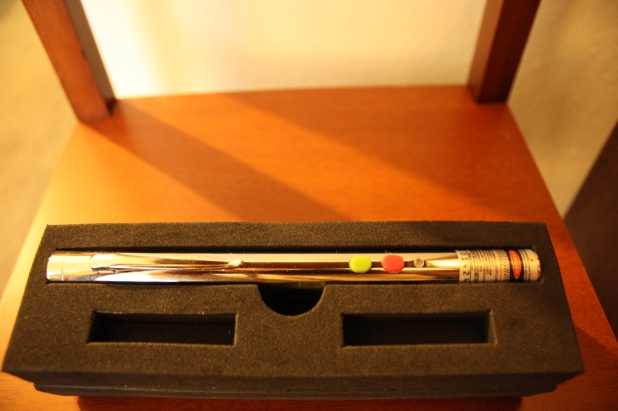
I Have A New Laser


It should come as no surprise to anyone that I like science. There is just so much about it that is awesome. Look at all the toys that science gives us, like R/C Cars and helicopters (Did I mention I got a new laser pointer?) Or what about all of those handy dandy tools, gadgets, and gizmos that we have, thanks to science. You've got things like power tools and non-stick pans and the triumvirate of computers, cell phones, and the internet. If nothing else, the lifesaving technologies that we have available to us (thanks vaccines!) are rooted in science. If you're of a more philosophical nature, when we seek to understand the world we expand our potential both as a species and as individuals. The knowledge that the scientific process creates can be used to enrich our lives. It can create new markets and new ways for people to exhibit their genius. Plus, science makes fireworks more awesome.

If I had to choose a favorite aspect of science then I must say that it is the scientific mindset. I like the idea of curiosity run rampant. But a curiosity self-tempered by critical analysis and empirical observation. I want to know about the world. I want to understand how it works. I find joy and beauty in reality. There is a depth and breadth of ideas available to me. There is a multitude of ways to explain the world. Some are right and some are wrong, and it is through critical analysis and empirical evidence that I can tell the difference. To me, the scientific mindset is innately curious, rigorous in its self-examination, skeptical, and above all, absolutely in love with the real world. That resonates with me.*

I think that what I find most attractive about this way of thinking is its versatility. The tools and techniques used in biological chemistry are vastly different from those used in astrophysics. How a historian goes about their business is different than that of a sociologist. The very nature of the topic explored dictates such changes. Yes, there is a ton of overlap between areas, and they all make use of mathematics. They may have surface differences, but they are fundamentally the same thing. And it is precisely that fundamental similarity that I am talking about. The drive to understand the world through logic and empiricism underscores much of science.

I have long thought that the mind of science could have much more widespread use than it does now. Consider social programs, such as foreign and domestic aide. We have to get a grapple on the magnitude and complexity of the problems; we have to find their cause. We have to figure out ways to cure or alleviate the symptoms, and we need ways to check that our plans are working. We could also consider civic law. What laws work, which don't? What are the ultimate goals of our laws? How can we know, for sure, that a law is no longer needed or has caused more trouble than it cured?

I wish to be clear. I'm not making the claim that we need more science literate people in congress. We most certainly do, but the effort is wasted if there isn't a corresponding rise in scientific thinking. We don't just need more science knowledge at play in our political system, we need a more systematic way of understanding our society. With a country as large and complex as ours, in world as large and complex as ours, we need some way to see what's going on. We can't just think up something, fight for it in congress, and hope things get better once it passes. We have to do research to make sure we haven't missed anything. We have to hypothesize an idea for what could work. We have to test this hypothesis out. This could involve more research, questionnaires, field studies or pilot programs. Once we have as much data, as much knowledge, as much understanding, of the problem and our solution as possible, we can then make it into law. We would of course do follow up studies to ascertain that program’s effectiveness, and we would always be open to the idea that there is a better way of doing things.** Given our current situation, any step in this direction is going be a step in the right direction.

I would begin with the political process itself.  As a citizen, I want to know as much as I can about issues and candidates. What has this person voted for in the past, what bills have they fought for? Speaking of, what about having an easily accessible repository of bills? You could link this in with a candidates voting history for a whole heaping helping of juicy data. I want to have such things because I want to make an informed decision when it comes time to vote. I want to see metrics galore of our society, with lots of statistical analysis. I want to see this data used to determine what works and what doesn't. I want us to lose our need of campaign promises and flawless leaders. I want us to lose our fear of failure.  In short, I want us to embrace the scientific mentality so that we can rationally decide what the best course for our society is.

That being said, it is unsurprising that I liked this article by Mark Henderson for The Guardian. He starts with a quick rundown of how science acts like an idea sieve, separating the good ideas from the bad. He then moves into the lack of the experimental thinking in government. He claims each new piece of legislation is a social experiment. Yet unlike with medicine, there are no experimental trials or pilot programs.

He then elaborates his point by putting forward several areas that could use a touch of experimental thinking, a dash of scientific reasoning. He hypothesizes that the school day be modified to match teen’s circadian rhythms. He also proposes a way to empirically prove which works better, prison or rehabilitation for drug offenders. He also shares his ideas on how foreign aid may benefit from scientific thought.

He certainly makes a compelling case, at least one argued better than mine. I truly think that, especially in a democracy, we need all the facts we can get. Science is great for that!


Awesome


*Which makes sense, since it's my definition
**A bit idealistic, I know. Ideals are perfect, and we can never achieve perfection. But we can come close. Just because something is impossible is no reason to stop trying.
Share/Bookmark

May 21, 2012

A Trend In Aberrations

I was fiddling around with Google trends today and noticed something weird. The trend for 'science' showed a clear pattern. I didn't do much other than note the oddity before moving on. But then I noticed something weird. Their was a striking similarity between the two trend lines of 'science' and 'religion', unsettling as if someone just repeated themselves without realizing it. Both trends seem fairly stable through the first part of the year, usually hanging out above 1. Near the middle of the year there is a noticeable drop in searches for both terms, with a rise back to above 1 by the end of  the year. Upon closer examination, there is a mysterious double dip in both trends, one in November and one in December. What could explain this correlation? Could it just be coincidence?


During the winter you're not out and about as much, and so are spending more time indoors doing more stationary hobbies, and you are more likely to be reading up on thoughtful subjects like science or religion. But there are still odd things happening. Sure, 'religion' sometimes gets a boost around Easter (especially in the U.S.) But what about the double dip at the end of the year? Each November there is a drop in both terms, followed by a rise through the middle of December, with another fall to the end of the year. Why such synchronicity? I like to think it is caused by holidays and travel arrangements. Looking at the graphs for "holiday travel" one can certainly see upswings right at the same time that 'science' and 'religion' nose dive. And there does seem to be a minor upsurge in searches for 'travel' during the summer, right along with the drops in the other two terms. I would also note that the summer plunge for 'religion' and 'science' coincides with the middle of May and the middle of August, right when school gets back in. There is a discrepancy between 'travel'-related searches and 'science/religion' searches, namely there is a big upsurge in 'travel' searches during January, but without a corresponding drop for the first two terms. But that may well be explained by people writing about their holiday travels, rather than actually leaving their house.

So I think I can, tentatively at least, conclude that the similar patterns exhibited by peoples search behavior in regards to 'religion' and 'science' (Specifically, a drop during the summer months, a rise during the winter, with a double dip in that rise occurring in November and December) is due to seasonal variability: When it is cold and snowy outside, people stay inside more. This means they spend more time on the computer, as well as having more time to engage in stationary pursuits, leading to a rise in searches for those two terms.

Further research is certainly required to completely answer this question. What effect does school have on the searches? The average number of searches for the two terms during the summer is half what it is during the winter, while searches related to 'travel' only upswing marginally during the summer. Are school age people doing most of the investigation of these two terms? What other terms have similar trends? What's up with science between 2003 and 2004?*

It was right around that point when I noticed there was another weird trend. Each year, right at January, there would be a huge spike in both trends. More specifically, the trend is always less on December 31st than it is for January 1st the following year. Why the sudden rise? There was usually a slight rise right at the end of December, but January would always start significantly higher than December ended. My first thought was that the new year had a part to play in this. But since the change is so rapid (overnight), and the trends after January 1st are fairly consistent, I'm lead to assume that Google trends averages for each year at max, and thus has to readjust each year in order to display on a multi-year graph. But then that implies that we are consistently seeking out these two terms less and less each and every year. This also is occurring with 'dentist', 'travel', 'home', and 'abroad'. Are we truly becoming less and less interested with the world, or is this some graphing problem with Google Trends?

Damn you random internet research!


I see your answer, and raise you another question! 


*Hypothetically (more accurate than theoretically) I could try and do the research necessary to answer these questions, but I'm not gonna. I think if I go any further I will start to verge into actual science or obsession. More likely the latter, but if the former than I am woefully inadequate for the task.

Enhanced by Zemanta

Share/Bookmark

March 20, 2012

America Sive In Dea Nova

Bad Astronomy | Discover Magazine:

'via Blog this'

A lot can happen, given enough time. But sometimes it is truly remarkable how quickly things can progress. It has been over four hundred years since Galileo first turned his telescope to the heavens and found that Jupiter was orbited by satellites of it's own. Let us consider the world of Galileo: Ships navigated by sextant, maps were ... interesting. The Dutch East India Company had just been founded and the New World was reached in boats that were little more that tar, timber, and nails.

But it is Galileo's new worlds that are of interest today. As Phil Plait mentions, when Io was first discovered we didn't even have accurate maps of the Earth. And now we have a photomosaic map of the Galilean moon Io at an accuracy that was not rivaled on Earth until the 20th century. In addition we have electricity, powered flight, instant pocket communicators, microwave ovens, rollercoasters, vaccines, plastic, life support helicopters, and really fast cars. We have put people on the Moon. Imagine what our world will be like four hundred years from now. I wonder what new worlds we will be exploring then.


Earth had a fat Antarctica back in the day. But then it took a stairmaster class at the local gym  and now it's buns and thighs look spectacular. Also, go to Ancient World Maps on Blogspot. They're pretty cool.

Enhanced by Zemanta

Share/Bookmark

February 28, 2012

Living Longer Than 40 - Thanks Science!


Living Longer Than 40 - Thanks Science!

In the movie Jurassic Park, Jeff Goldblum's character Ian Malcolm is explaining to Laura Dern's  character Ellie Satller a bit about chaos theory, and how similar events can lead to vastly different outcomes. In his example, that would be the placing a drop of water onto Dr. Sattler's hand and seeing where it rolled off too. In my case the similar events are a rather silly question.

I see this type of sentiment sometimes here and there. People express it differently to be sure, but it happens a lot. The question comes in many different flavors, each with their own nuance and character, but they all essentially boil down to one simple question "What has science done for me?/done for me lately?" What's different about this time? Nothing! Nothing that I can tell, anyway. What got me going was a comment online (yeah, you'd think I'd learn, but no) Someone said that the space program is a waste of money. I've heard it before and I'll hear it again.  So why did this one get under my skin? I blame Jeff Goldblum. 

So in response to that mentality, here's a list of stuff!

  • Flying - Thanks Science!
  • Not contracting polio - Thanks Science!
  • Cell Phones - Thanks Science!
  • The Internet - Thanks Science!
  • Connecting to the internet on my cell phone while flying and not dying of polio - Thanks Science!
  • Dr. Pepper and the containers thereof - Thanks Science!
  • Distillation - Thanks Science!
  • Plastic - Thanks Science!
  • For the numerous contributions to construction, architecture, chemical adhesive, latex paint and everything else that went into making the chair your sitting in, the house your living in, and the bridge you drive on - Thanks Science!
  • Lasik Eye Surgery - Thanks Science!
  • Surviving Surgery - Thanks Science!
  • Germ Theory and Sanitation - Thanks Science!
  • Penicillin - Thanks Science!
  • Living with diabetes - Thanks Science!
  • Surviving a heart attack - Thanks Science!
  • Pacemakers - Thanks Science!
  • Chemotherapy and those who live - Thanks Science!
  • Knowing our origins - Thanks Science!
  • R/C Cars on other planets - Thanks Science!
  • Hubble Deep Field - Thanks Science!
  • The Pale Blue Dot - Thanks Carl!
  • Comprehending the vastness of the universe, and our place within it - Thanks Science!

The next time someone asks you a question like, "What has science done for me lately?", you look them straight in the eye and ask them, "What have you done for science … ever!?"
Enhanced by Zemanta

Share/Bookmark

January 20, 2012

How to Settle, Once and for All, the Whole "What's a Planet?" Debate | New Planets | DISCOVER Magazine

I like this article. There's one part in particular I enjoyed, where the author is talking about how scientists work with concepts, and not definitions. Which is why Pluto was ultimately demoted. Scientists changed their concept of 'planet' after finding a whole bunch of other objects in the solar system. The concept of 'planet' no longer includes Pluto, which is fine. As N.D. Tyson says, "We put Pluto with it's brethren." Pluto is now the star of a whole new concept in the solar system.

How to Settle, Once and for All, the Whole "What's a Planet?" Debate | New Planets | DISCOVER Magazine:

'via Blog this'

This also clears up a misconception about the Linnean taxonomic system. We don't define animals, like the Desert Horned Lizard. Sure, we call it Phrynosoma platyrhinos, of the Family Phrynosomatidae, Order Squamata. But these classisifications are only concepts that help us find order and connection in the natural world. We do not define the natural world. But we do have conceptions about the world, and these conceptions help us to learn about the world. For example, because both the Desert Horned Lizard and Short-horned Lizard are in the Genus Phrynosoma I know that those two creatures are related. Why? Because the concepts of evolutionary biology and the Linnean taxonomic system.

Share/Bookmark

November 28, 2011

I don't understand this...

Ok, so one of the things climate change deniers do is to claim that the scientists are only in it for the money. (First mention in the third paragraph) This doesn't make any sense. Has anyone ever seen a scientist on MTV Cribs? No, and it's not just because science isn't seen as cool enough or whatever. It's because scientists, by and large, are not rich. Those few who are did not make their money from grants, either. They wrote best selling books after and during a successful career in science.


The mad scientist is one character type freque...
Image via Wikipedia


Lets say we give a scientist a million dollars. We tell them to do whatever they want with it. Sure, they'll buy tools for their shop, maybe something nice for the spouse, but they won't go nuts. You give a scientist a bunch of money and they are more likely to by an electron microscope than a Ferrari. A scientist is interested in research, experimentation, learning about the world and being enthralled by its beauty. About the only reason your average scientist has to buy a big screen TV is so that they can properly render their high speed, data collecting footage.  So I'm not sure where these deniers are coming from, thinking scientists are money grubbing bastards. But whatever, they are allowed their opinion (despite the fact that they get their talking points from oil company billionaires)

But that's not the oddest thing. I could see how someone might be cautious about signing over a massive amount of cash to someone, with no idea what they are going to do with it. But the money the deniers are talking about is grant money. It's not a personal check. It's a highly sought after, discrete amount of money that is only for a specific purpose - Grant money goes to the school they do their research at more than the scientists themselves. What does go to the scientist is their salary. Unless you don't think people shouldn't get paid for the work they do, there isn't much of a problem with this. And of course, that salary comes from more than just grants. Things like tuition and stuff also goes into their salary. Because research scientists at universities are also (gasp!) teachers.

I just don't understand the money angle. Scientists aren't in it for the money. If they were it would be obvious. They'd drive better cars, have bigger apartments, not waste their time teaching people, things like that. If you want to be rich, strike oil. If you want to learn about the world, be a scientist. Money is not a motivation for a scientist to undermine science.

While it was hard to find any sources that actually said where they got their figures from, I did find that most were in a similar range, and matched well with those from either: Reputable sources; or sources which detailed their data collecting technique. Here are a few, just to show that most scientists don't make much money.

http://money.cnn.com/magazines/moneymag/bestjobs/2006/top50/index.html
http://www.simplyhired.com/a/salary/search/q-Science
http://www.simplyhired.com/a/salary/search/q-Research+Scientist
http://www.indeed.com/salary/Research-Scientist.html
http://www.indeed.com/salary?q1=Scientist&l1=
http://www.indeed.com/jsp/about_salary.jsp

Sorry for the quick and dirty linkage, but I don't feel like cleaning them up right now. I used CNN, Simply Hired, and Indeed.com for my sources.
Enhanced by Zemanta

Share/Bookmark

November 22, 2011

Linkage: Science & stuff

Ok, so yesterday I posted a bunch of links. They all had to do with space. This time I've done the same, but with only three links about space! The rest is interesting too.


Share/Bookmark

October 14, 2011

English Essay 2 - Cosmos

I wrote this for my English class, just turned it in today. Which means that I can now post it!

                Cosmos has been one of the most enduring and popular series on television. Premiering in 1980, the 13 episode series was hosted by astronomer Carl Sagan, who also wrote the series along with his wife Anne Druyan and their partner Steven Soter. In a break from previous science television shows, Cosmos did not limit itself to just one area of study. The breadth of the show goes from the tiniest particles then known to the largest scale structures of the universe. But at no point does the series lose its sense of humanity, and that is I think what has made the series consistently relevant. We are shown the wonders of the universe, and rather than being alien and remote these awe inspiring wonders are intricately linked to the deepest parts of ourselves.

                Cosmos spoke to your heart. Its opening image is of a vast star field with ethereal music drifting out of your speakers. The series begins with a man and his imaginings as he ponders science, humanity, and the universe. This show was Carl Sagan's vision. He showed us all how he saw the world. He took such a joy in existence, and was so good at explaining it, that you couldn't help but feel as he did about this universe we inhabit.

                Carl Sagan was the perfect host for this show. He was calm, intelligent, and personable. He saw beauty in everything, and he could communicate that beauty to you with ease. Though most famous for this show, and quite accomplished in astronomy, he was most prolific as a writer.  I for one don't mind that at all. He wrote beautifully, eloquently; powerfully. He wrote with a clarity that could leave you breathless. He explained scientific principles with such passion that you were automatically enthralled. His compassion for individual people could be heartbreaking. Richard Dawkins has said that science is the poetry of reality. If that's true, then Sagan was its poet laureate.

                But the show was about more than the simple eloquence of a man. It was about the wonder and beauty of the world, and our place within it. The first five minutes of the very first show exemplifies this. Standing on a cliff by the ocean, he tells us of the immensity of the cosmos. Interweaved within this he extols our accomplishments over the past few millennia, he expounds upon what humans have done. He shows us that the universe is vast, and that we are just a small part of it. He tells us of our potential and our danger. He puts us into the cosmos, connecting us, small as we are, to the largest concepts possible. We are, as he was fond of saying, made of star stuff.

                Each episode takes the form of travelers' tales, short stories interwoven and interrelated. Each on its own insufficient to be compelling, but in combination they are complex and subtle and powerful. Each small bit complements all the rest. He begins on the shore of an ocean, comparing the vastness of the cosmos to the vastness of the sea. Like the sea, the stars are where we came from. The atoms and molecules that we are all made of were themselves made in the fiery heart of a dying star. There is a sense of returning home, both to the ocean and to space.  Through this episode he documents our curiosity, our drive to understand, and our courage. He forms a compelling argument that not only is exploration built into the very fabric of Humanity, but that we are capable of truly becoming an interstellar species.

                In the second and third episode he starts using the metaphor of music. He starts by applying it to biology, and the possibility of life on other worlds. He compares it to singing, that we are but one voice in a cosmic fugue. He continues with this metaphor when he investigates our obsession with finding the cycles and harmonies of nature. He walks the path from astrology and farming to keeping a calendar and the cycle of life and death. He shows how these ideas were applied to early astronomy. He discusses the 'harmony of the spheres' and how we gradually learned more about our solar system. This culminates in the story of Johannes Kepler.

                Kepler was an astronomer who for years struggled to find a way to understand the movement of the planets using platonic solids. The way he saw the world, the way he was taught to see the world, relied heavily on ancient Greek scholars. Like Pythagoras, Kepler assumed there were whole number harmonies throughout nature. He used the five Platonic solids as his basis for astronomical geometry, and applied Pythagorean ideas to their motion. We learn of his struggle with these ideas. We watch as he spends years doing calculation after calculation, none of which work. We also watch as he throws out all his preconceptions, and we learn about the insight that finally let him understand what was going on. His work laid the foundations of all modern astronomy, and this was only possible once he was willing to admit he was wrong.

                In Cosmos we are taken on journeys into the past. We learn of our history, and the history of science. Scientific ideas are not often created and proven in one generation. Democritus, we learn, was trying to prove that we are made of atoms over two thousand years ago. It wasn't until the sixteenth century that we saw mountains on the moon and the clouds of Jupiter. We have sought to understand gravity for millennia, electricity for centuries, genetics for generations, and ourselves for ever.  To tell these stories we must understand not just the facts, but the context. We have to know the people and the world they lived in. We have to follow the growth of an idea, sometimes for thousands of years. This is not an easy task, but Sagan was a master story teller.

                I have touched on just one story that Sagan tells us in this series. There are many more. In each one,Cosmos made use of some new technology: Computer graphics. Sagan does not use such technological wizardry gratuitously, but artfully. When he uses a model of the Library of Alexandria as a digital backdrop it feels entirely appropriate. Though the issues he is talking about at that point are quite diverse, they all have a connection with the Library. Looking at it now, it is obvious that Sagan was digitally dropped into a shot of a model. To be honest, the scene may have been more realistic if they had used a painted backdrop. But with a digital image you can pan and zoom, change angles and walk through doorways. You can't do that with canvas. It's these options that make the use of digital technology the right choice. Whether it's a scenic library background or the information of the mind portrayed as great shelves of books, the use of digital is not gratuitous. The visual metaphor perfectly complements the verbal.

                They are however, late seventies computer graphics. They aren't, given the standards of today, that good. But we can get a measure of how good they once were by examining the documentaries that have followed.   Earlier documentaries were bland. They were appropriate for school use, and given the alternative (black and white textbooks) were certainly appreciated. But they were not emotionally compelling. We learned about science sure, but we didn't learn anything about why scientists become scientists. Some, like Wild Kingdom, were excellent. Most, however, featured a middle aged balding man with a monotonous voice who was usually holding something sciency. But after Cosmos that changed. Graphics were used much more extensively. The hosts were expecting to have at least some personality. The BBC started producing a variety of series on science that incorporated ideas from Cosmos. This legacy continues today with such films as Wonders of the Solar System andThrough the wormhole with Morgan Freeman. Even we yanks have gotten into the act, courtesy of Discovery channel, History Channel, and Family Guy. Well, more the first two than the last. But Seth McFarlane is producing the next completely new series of Cosmos, premiering on Fox in 2013, which is just plain old fashioned exciting. I wonder if Peter Griffin will be the host. I hope not, but still, that would be amusing.

                Cosmos has been translated into over forty languages, broadcast in sixty countries, has been re-mastered, re-edited, updated and re-updated at least a dozen times. It continues be cited as inspiration by some of our top scientists, as well as have consistently high ratings when re-broadcast. The show is so enduring because of its strength of vision. Sagan artfully balanced factual data and human spirit in his stories. He was awestruck by the cosmos and that there are such creatures as we to observe it. His demeanor, his speech, his thoughts and the images he brought forth all tie into each other, are connected to each other.  They weave together into an intricate tapestry, an epic tale greater than anything you can imagine.


My take on the subject is a little more nuanced than this, but still. I find this amusing.


"The cosmos is all that is or ever was or ever will be. Our feeblest contemplations of the cosmos stir us - there is a tingling in the spine, a catch in the voice, a faint sensation, as if a distant memory, of falling from a height. We know we are approaching the greatest of mysteries."
-Carl Sagan

Share/Bookmark

March 31, 2011

The Beauty of Science

There are some who say that attempting to break apart and analyze the world removes from the world some of its beauty. I myself have seen examples of exactly this phenomenon. But not all times does understanding the world take something from our perception of the world. Let me tell you a story.

In the beginning of all things, there was a god awful bang. In this explosion were created two hydrogen atoms. These atoms, in concert with many trillions of their kin, existed as they had done since their creation. A vast cloud was formed of them, as they waited patiently for billions of years as other stars were born. It was not until a nearby star, formed from the same elemental hydrogen, came to the end of its life, that our star began its coalescence.

Unable to sustain its process's of nuclear fusion, this nearby star collapsed and rebounded in a massive explosion which created the shockwave that started the collapse of our cloud of hydrogen. Our two atoms, having waited through the eons, have at last started the long process of coalescing into a star. After many millennia swirling around the cloud's center of gravity, these two atoms will arrive at the edge of what will one day be our sun.

They are taken down into the broiling heart of our new-formed sun, and there, at the end of all their waiting, they are brought together under intense heat and pressure in a process which will produce one atom of helium. The fusion of these two atoms released energy, energy which had been stored within the two original atoms since the moment of their birth. The energy from the formation of the universe was used to create these two atoms, and in their transformation into helium some of that energy was returned to the universe. This energy became a photon, a particle of light.

This particle, birthed in the fiery center of a star, began its torturous journey to the surface. There is a lot of matter in the depths of our stellar neighbor, and for millions of years our photon struggled against the amassed weight of material pressing down against it. But after many centuries of hardship, our photon finally broke free from the tyranny of the sun. Once released, this photon began traveling away from its stellar nursery, on into the vasty night between the worlds. Flying past the roasted world of Mercury, and barely glancing at the clouds of acid encircling Venus, our photon finally reaches our pale blue world. Light travels fast, more than 186,000  miles a second, but even at this breathtaking pace our photon must travel for more than eight minutes before it can reach our home planet.

As this photon enters our atmosphere, it's wave becomes bent and curved in accordance with the immutable laws of physics. Created in the heart of the star, and born from the union of two atoms created at the beginning of all things, having fought its way clear of the sun and traveling through the empty miles of space, bent and scattered by our atmosphere, our photon finally reaches the surface of our fair planet.

Our photon may strike a rock, or a tree, or a rooftop. It might splash into the ocean or rebound off of bare earth. But once it does strike, it briefly becomes a part of whatever structure it just impacted. The energy contained within the photon is absorbed by the material. Our photon, with some slight changes brought on by its interaction with the Earth, is emitted once again, travels through the atmosphere, and enters my eye.

This preserved energy from our creation gets absorbed in my retina and travels, as electrochemical impulses, from my eye along a nerve which leads to my brain. This impulse is sorted and used, is transformed into an image. This photon, along with trillions of others just like it, have come together to create an absolutely stunning sight: sunset over the mountains. The fires of creation have been preserved through these aeons in order to create jaw dropping beauty.

Knowing how the world works does nothing to detract from its beauty. Quite the opposite in fact.


Share/Bookmark

August 19, 2010

Absurdity

I stumbled across Conservapedia, the "trustworthy" encyclopedia. There were many gems in that internet tome, but I should to like to highlight for you just one right now.

"One way to measure open-mindedness is to test for close-mindedness, and then take the converse. A subject for our measurement can be asked if he views certain proposals as impossible. By impossible I do not mean mathematically impossible, but so unlikely as to be considered absurd. Belief in impossibility is a sign of close-mindedness, because it reflects the unwillingness of the subject to be "receptive" to the possibility."

And what if that something actually is impossible or so far outside the realm of practical application as to be impossible? Wouldn't that be a good to thing to know? And an open mind does not mean instantly agreeing with a contradicting view. It is simply listening to what they have to say on the topic. That's it. That's all. Nothing about agreement. If their arguments and evidence are sound and you have no plausible objections than great. If not, than there is no reason to believe the contradicting view is accurate or correct. An open mind listens to an idea and judges it's worth. If we have ample evidence of the mathematical validity for gravity and we have observational evidence to support the relativity based theories of gravity than we have no reason to believe that anything other than relativity must be correct. And if, or as is more likely when, we find certain discrepancies between theory and observation, we can use that discrepancy to understand where we went wrong, why we went wrong and we can figure out a better description of nature. That's some of the beauty of science. We attempt to understand our world to the extent of our ability to observe it in order to predict what we will observe next. Science always accepts the possibility that it may be wrong. But science uses it's inaccuracies to become more accurate, more correct, and closer to the truth. Or, as Dara O'Brian points out, "Science knows that it doesn't know everything ... otherwise it would stop."


Share/Bookmark

May 25, 2010

The Function Of Superconducting Quantum Interference Devices


Science fiction is known for having weird, far out technologies. But sometimes what was once fiction becomes reality1.  I have never been completely sure whether it's the fiction influencing the science, or whether a science fiction writer, presumably well versed in science, can see possibilities that someone immersed in science cannot.  I found both possibilities intriguing. If fiction influences reality, than that is a clear demonstration of how we Humans are capable of creating just about anything that we can imagine. It basically getting together and thinking logically about a concept until it becomes real. And that's essentially what's going on in this situation. Someone dreams up some crazy technology, maybe to resolve a plot point or maybe just because the idea is really cool. A scientist reads it, and then sets about trying to make it real. Some one imagines a concept, and someone else creates it. Or maybe a writer can see new possibilities. Sort of like thinking outside the box, or how an outsider sees more of the game kind of thing. An intelligent, thoughtful person who dedicates themselves for a time to learning about a subject can sometimes have amazing insights into the subject. Since your average person is quite capable of being thoughtful and intelligent (though they don't always realize this potential) this would be a clear demonstration of how ordinary people can achieve extraordinary things. A scientifically literate society which happily funds scientific research would likely give gains in both situations.  Which ultimately is the answer to the question, does science fiction influence science, or does science fiction see what science can't? It's a little bit of both.  Science fiction can feed the imagination of a scientist. That scientist then produces results. A fan of science, who possibly writes science fiction, may be able to make the subtle connections between the results, thus pointing the way to further scientific breakthrough.

Of course, some things in science fiction are more likely to generate a real world analogue. And some things in science fiction, while not having a true analogue, will have certain striking similarities. Generally the names for things in science fiction can have striking parallels in reality. Conversely, some real science can sound like fiction. I can easily imagine a writer somewhere utilizing Superconducting Quantum Interference Devices to get the hero out of a pickle.  It sounds like something straight from Star Trek, like the Heisenberg Compensator, or bio-mimetic gel, or transparent aluminum2 (Which is a direct translation from fiction to reality). Which I don't think is really all that amazing, since most of the names for things in science fiction use real world concepts. However, SQUIDS3 are completely real, and while not acting as a suitable plot device, they do serve several functions in medical and biological contexts.

I think there are a number of scientists, such as Michio Kaku, who treat science fiction as a wildly game of "Can I make that real?" There may be no real intention of creating a Batman-style grappling hook4, or a suit like Iron Man's. But to try and create something like that anyway is just plain fun.  And fun is half of science. A scientist loves to connect the dots, a scientist enjoys immensely put the pieces of a puzzle together. A scientist has fun doing their job. So science is just as much about random association as it is about logical thought. Attempting to create something from science fiction can highlight previously ignored facets of science or inspire ideas for new and innovative technologies. Working on something like force fields or light sabers, while not likely to come to fruition, can often still yield interesting and useful real world applications of science.

Incidentally, Michio Kaku wrote a book and subsequently hosted a show on the science channel call "Sci Fi Science: Physics of the Impossible" wherein he tried to create science fiction realities such as force fields and light sabers. One episode of the show was dedicated to creating a suit like Iron Man's, though he did add one capability to this suit: Mind reading. He figures that one could use atomic magnetometers5 to passively read someone's mind.  Interestingly enough, these devices, as he points out, can also be put to use imaging someone's brain or other body part in a way that is far more compact than current imaging machinery, and would likely be cheaper than current methods.  You can see the development of this technology here6, here7, and here8.

What really gets me about this is the time frame in which the technology has had to operate in. I'm not thrown so much by the progress and duration of its development as I am by the political climate that was in place during its development. The first two papers come from 2004, and the last from 2008. With all the talk of health care last year, and with all of Obama's pre-presidential campaigning for scientific development (of which some measure has been seen during his presidency9), one would assume that this technology would have been brought up, discussed, and made generally known.  I would imagine that a strong candidate for future medical technologies, such as these atomic magnetometers,  technologies that not only makes health care cheaper but also makes certain medical treatments more accessible and spurs on new medical technologies would have been used as a poster child for the need for health care reform and scientific research. 

The medical field is currently burdened with drug and technology companies fighting for the greatest profit margin. This tends to make these companies more cautious, repressing the risk taking that could generate a new technology. This also tends to force a company to defend its profit margin by any means necessary, such as preventing other companies from developing new technology.  These companies have a vested interest in maintaining the superiority of their product.  Lobbying on behalf of these companies hampers  scientific research by forcing politicians to restrain new developments, new lines of research, new technologies. Repressing scientific research severely constrains the potential of a society. We are a culture of visionaries. We can see new possibilities, and work to achieve them.  Scientific research can have direct and profound impacts on our living conditions.

This one specific technology, or even a handful of others such as low intensity MRI scans10  or interferometric synthetic aperture microscopy11 would have lent weight and credence to both arguments, that our health care system needs reform (Our money hungry system denies the citizen of promising technology as a byproduct of that hunger) and that pure scientific research is important (As evidenced by these technologies)

Which brings us to the big questions:  Why haven't these technologies seen more government funding? Why haven't these technologies seen more media coverage?


________________________________________________________

1 John Blodgett, Continuum, "When Science Fiction Becomes Reality", University of Utah (2009)
2 Live Science Staff, Live Science, "Military: New Aluminum Windows Stop .50-Caliber Bullet" (2005)
3Wikipedia, "SQUID"
4 Gizmodo, "MIT student creates real life Batman utility belt"
5 Wikipedia, "Magnetometer"
6 I.M. Savukov, M.V. Romalis, Physical Review Letters,  "NMR Detection With An Atomic Magnetometer", Princeton (2004)
7 P.D.D. Schwindt, S. Knappe, V. Shah, L. Hollberg, J. Kitching, L. Liew, J. Moreland, Applied Physics Letters, "Chip-scale Atomic Magnetometer (2004)
8 A.S. Levitt, The Future Of Things, "Atomic Magnetometers to shrink MRI" (2008)
9 D. Vergano, USA Today, "  Scientific Climate Is Changing As Obama Takes Office" (2009)
10 E. Rotman, The Future Of Things, " First Low-Intensity MRI Scan Of A Human Brain" (2007)
11 G. Molho, The Future Of Things, "ISAM - Computed Image Revolution"
Share/Bookmark